 - v2.jpg)
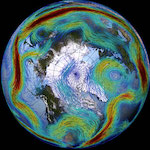 IMAGE COPYRIGHT https://oceanservice.noaa.gov/
 Maths with a twist
Fluid dynamics is a subject with a long history representing a virtual parade of famous mathematicians. Yet, we continue to make discoveries and find applications that impact on our everyday life. For example, we now have reliable 5-day weather forecasts and tornado warnings. Predictions of tides are applied to automated tsunami warnings and mathematical models of planetary flows are crucial for understanding climate change.
Many challenging problems involve vorticity. On the small scale, one immediately thinks of turbulence while vorticity on larger scales impact on the weather. For example, the so-called Rossby waves in the oceans are associated with a phenomenon known as El Niño which affects meteorological conditions in the Pacific Ocean. The waves are relevant for astrophysics, especially for neutron stars for which they are thought to be a detectable source of gravitation radiation.
We all know what water is - and we know that it can be a lot of "fun"! - but as this exhibit demonstrates, we do not understand all aspects of it. For example, wood floats and metal sinks, but is this always true? Join members of or Applied Mathematics groups and explore simple hands-on demonstrations of fluid behaviour, various fluid instabilities and vortex dynamics - connecting to interesting problems on many different scales.
Many challenging problems involve vorticity. On the small scale, one immediately thinks of turbulence while vorticity on larger scales impact on the weather. For example, the so-called Rossby waves in the oceans are associated with a phenomenon known as El Niño which affects meteorological conditions in the Pacific Ocean. The waves are relevant for astrophysics, especially for neutron stars for which they are thought to be a detectable source of gravitation radiation.
We all know what water is - and we know that it can be a lot of "fun"! - but as this exhibit demonstrates, we do not understand all aspects of it. For example, wood floats and metal sinks, but is this always true? Join members of or Applied Mathematics groups and explore simple hands-on demonstrations of fluid behaviour, various fluid instabilities and vortex dynamics - connecting to interesting problems on many different scales.
You may also like

The mathematical story of seven bridges
Join us for a journey back in time to the city of Konigsberg and its famous bridges! In this hands-on adventure, you will uncover the mathematical secrets behind journeying this ic ...Read More
Highfield Campus
Making Smart Decisions in an uncertain world
Join a team of mathematicians and statisticians from the School of Mathematical Sciences to discover how you can make smart and responsible decisions when faced with uncertain situ ...Read More
Highfield Campus
